Category Archives: gluten-free

Rocket Beans

One good thing the coronavirus has given me is some time. It all felt very stressful in the beginning but now with everything closing down, not having to organise work or rushing here and everywhere, everything has slowed down. I’m also avoiding wall to wall reportage, just listening to enough news to keep up, and thinking of all the things I can get done now that I have some time.

Funny how I want to fill it!

This is the first recipe since last year Halloween!

And here is what we had for dinner last night…..

Beans take time to cook – even if you open a can, they always benefit from a little bathing with the other ingredients.

This recipe is for beans cooked with melted down onion and fennel, cooked until just before they caramelise. I put in a Parmesan rind at the same time and this creates a creamy unctuous side to the whole affair but leave it out if you don’t have one or want a vegan version.

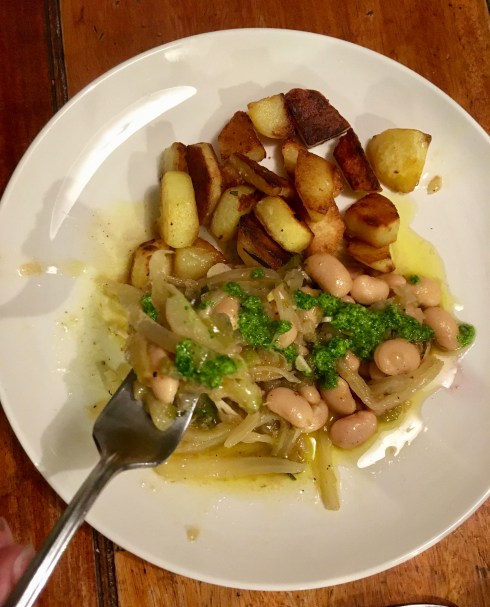
This recipe began as Beans and Greens in my repertoire but it was dark last night when I began to cook. Too late to pick greens but I had some rocket in the fridge that I made into pesto which I drizzled over  when serving. We ate the beans with chippy potatoes on the side.

Below are the instruction for cooking dried beans but last night I opened a jar!


Rocket Beans

150g dried cannellini beans or a can or jar drained and rinsed.

1 – 2 onions

2 stems celery

1-2 small fennel

2-3 cloves garlic

parmesan rind (optional)

olive oil

salt and pepper

1 glass white wine


100g rocket – chopped

1 dip pine nuts

100=150mls olive oil

1-2 cloves garlic- peeled and chopped

A squeeze of lemon juice

50g grated parmesan


Soak the cannellini beans overnight in cold water.

Bring enough water to cover the beans to the boil then drain and rinse the beans, tip them into the pot and bring back to the boil. When the beans are boiling turn to a low simmer and cook gently for 40 minutes then check them to see if they are tender, they will probably need more time so if they need longer cooking check every ten minutes until the beans are cooked. Drain, reserving the cooking liquid.

Whilst the beans are cooking, peel and chop the onions. Heat a saucepan, add enough olive oil to cover the bottom then add the onions. When the onions are sizzling reduce the heat and cook for five minutes.

Wash the celery and chop into four strips lengthwise then chop into a small dice and add to the onions.

Wash the fennel, chop in half then slice thinly and add to the pot.

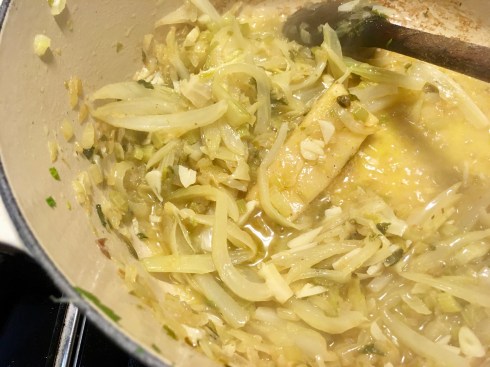
Season with a little salt and freshly ground pepper – this will help the vegetables to melt down and add the Parmesan rind if you have one.
fullsizeoutput_1b1b

Cook the vegetables gently until they are are soft and translucent, this will take 20-30 minutes, then peel and chop the garlic and stir in. Cook for another five minutes then add a glass of white wine, let it bubble up then add the drained beans and enough cooking liquid to just cover the beans. Use water or stock if you have opened a can/jar.  Season with salt and pepper then simmer the beans for 20-30 minutes. The liquid will reduce  – the beans shouldn’t be swimming in liquid when served but keep enough to have the beans sitting in a little sauce.

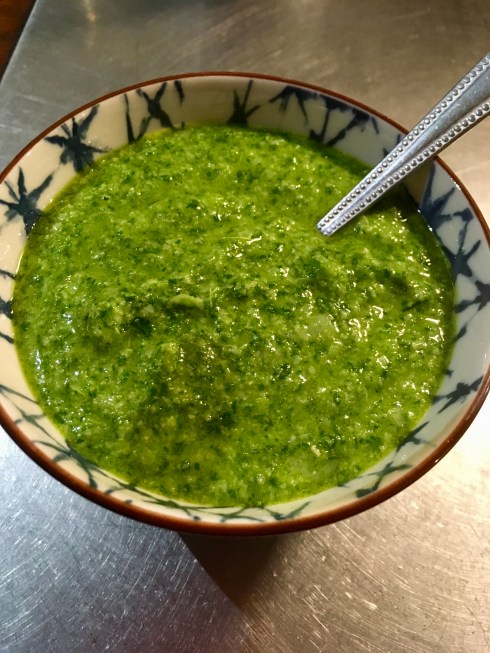
To make the pesto put all the ingredients into a jug and buzz with a handheld blender.

Adjust the consistency and season with a little salt
fullsizeoutput_1b22

To serve, put a ladleful of beans onto each plate and drizzle over a little pesto
fullsizeoutput_1b21


Vampire Soup with Optional Eyeballs

fullsizeoutput_18b3

Beetroots have been around since the Romans who enjoyed their earthy charm.  The root and leaves have been eaten for centuries. They also had a moment of glory when it was discovered that beetroots could be converted to sugar but these days these brightly coloured vegetables are known more for the fact that they’re packed with vitamins, minerals and antioxidants. The colour of the beetroot that makes everything that it touches turn some shade of pink/red/purple seems to perk people up. Antioxidants or not their colour certainly cheers things up on a rainy day


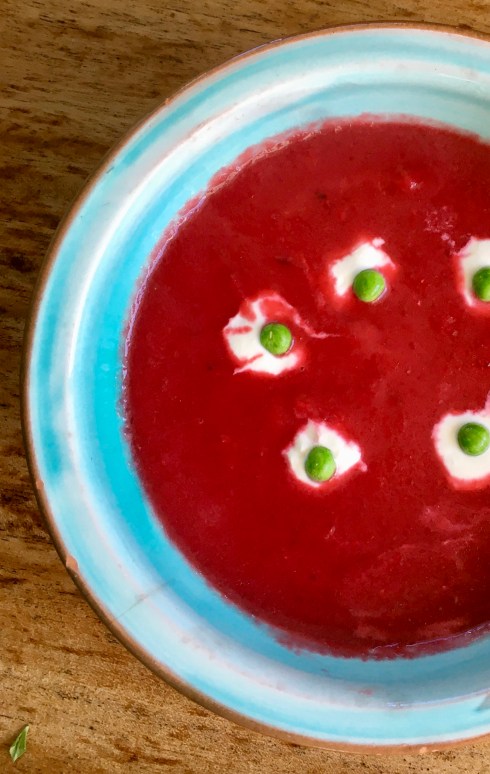
To celebrate Samhain and Halloween I ‘ve made this this sensational Vampire soup with optional eyeballs. The soup is in fact a sophisticated marriage of beetroot and fennel gently cooked into sweet submission and adorned with crème fraiche but with a little imagination and a few peas it transforms into a ghoulish delight.


The Vampire title may entice your children to try this stunning soup and the optional eyeballs are easily achieved by posting a pea on top of a little spoonful of crème fraiche and setting it afloat.

It could be just the thing for Halloween

You could even organise an eyeball eating contest.


Here’s the recipe

It’s very easy to make, It doesn’t matter too much  the size of the beetroots that you use, it’s more important that they are fresh so don’t use ones that are pre cooked and vacuum packed.

Choose about three big or six small beetroots


Beetroot and Fennel Soup


1 onion

75mls olive oil

1-2 stems celery

1 fennel

1 potato

3-6 beetroots

800mls vegetable stock

A squeeze of lemon juice


Peel and chop the onion

Heat a saucepan, add the olive oil and onion then cook on a medium heat.

Chop the celery into 4 lengthwise then dice small and stir in with the onion.

Trim the fennel then cut into half and chop finely.

Stir in with the onion and celery, season with a little salt. Keep the vegetables gently humming away in the pan. Turn the heat up and down until you’re happy the gentle sizzle is not burning. Peel and dice the  beetroots and potato small, add to the pan and stir into to combine leave to cook for another 10 minutes with the occasional stir. Season with salt,  Add the vegetable stock. Bring to the boil then cook at a gentle simmer for 15-20 minutes.

Blitz until smooth, add a squeeze of lemon juice, taste, then adjust the seasoning.

Serve with a swirl of creme fraiche


Tomato Party

fullsizeoutput_15ac


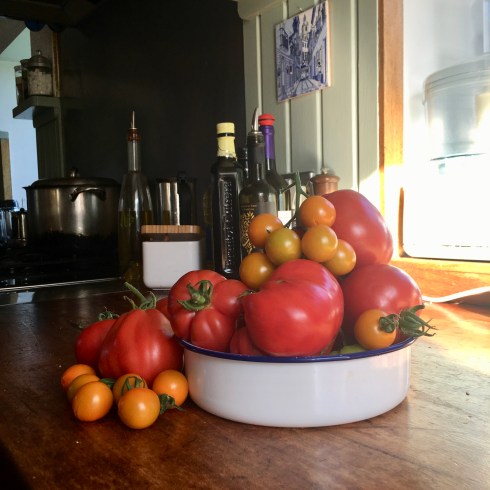
The time we have been waiting for all summer has arrived. The tomatoes have ripened and we are enjoying them with nearly everything. Breakfast, lunch and dinner.

We grew fifteen varieties of tomatoes this year, all selected for their flavour rather than prolific production or uniform size. The names are curious but in fact somehow apt when you see the fruits –  Bottondoro, Mountain Magic, Fandango, Liguria, Ox Heart, Moon Glow….. They’re all shapes and colours,  red, orange, pink, and yellow .

We let the tomatoes ripen on the vine, this guarantees that they are bursting with flavour and not all picked at once. There’s always a bit of a wait for the tomatoes to ripen but we are usually still picking them in moderation well into the autumn

Each variety has merits, the Bottondoro – orange cherry tomatoes are delicious roasted , we’ve been spooning them onto and over things with a dollop of creme fraiche. The Fandangoes, Ox Hearts and Moonglows have been cut into a chunky dice and consumed with just a drizzle of olive oil and a sprinkle of  sherry vinegar and salt. They don’t need any fancy treatment.

We ‘ve also made pasta, stews, soups, risottos and most of all ‘pan con tomate’ the Spanish go to breakfast.

Pan con tomate is toast rubbed with a smidgeon of garlic, a drizzle of olive oil and tomato which is rubbed on the toast or grated.

Grating tomatoes is a very useful kitchen trick.

Simply take a large ripe tomato, cut it in half and grate it flesh side down, over a bowl, on the coarse side of the grater. The result will be a fresh tomato passata in the bowl and a tomato skin in your hand. Just bin the tomato skin and the tomato is ready to use.

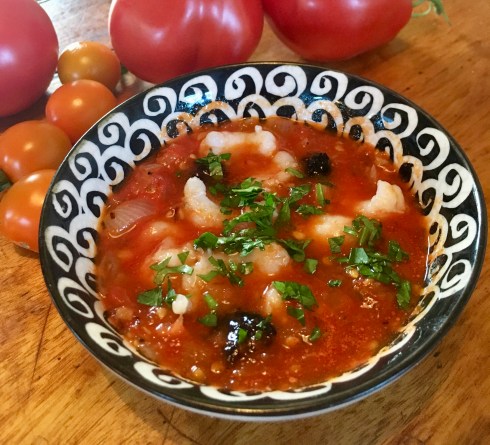
Here is a recipe for a Greek dish, using grated tomato.  Prawns with Ouzo and black olives are the original incarnation but Ouzo which is a Greek aniseed flavoured aperitif can be replaced with whatever you have in the drinks cupboard. I use Pernod but brandy or white wine would work too.

This is delicious mopped up with bread or served with basmati rice or pasta for a main course. Fresh prawns would be the ultimate but uncooked frozen prawns will work too just be sure to dry them well before frying.

Serves 6 for a mezze, 3- 4 for a main course

fullsizeoutput_15ad

Prawns with Ouzo and Black olives


500g fresh peeled prawns – not already cooked

75mls olive oil

1 small onion

2 cloves garlic

2-3 large ripe tomatoes – about 500g

a good pinch of dried oregano

a small glass of Ouzo or Pernod

1-2 tbs black olives

salt and black pepper.

chopped flat leaf parsley


Peel and finely chop the onion

Peel and finely chop the garlic

Cut the tomatoes in half and grate on the coarse side of the grater, holding the skin side. Discard the skins

Dry the prawns on a little kitchen roll.

Heat a small frying pan, add the olive oil then the prawns. Cook for a couple of minutes until the prawns just change colour. Lift out of the pan and put aside.

Fry the onions until they begin to soften then stir in the garlic and cook for a minute or two. Add the grated tomatoes, oregano and the ouzo or Pernod. Let the sauce bubble up and reduce for a few minutes. Stir in the prawns and black olives then cook for anther 3-4 minutes. Take off the heat, season with salt and pepper and garnish with chopped parsley.


Rabbits and Raspberry Pancakes

We have a rabbit in our garden, It has been hopping about devouring beans and kale and now it’s systematically chomping through a row of cauliflowers. This is an unusual problem for us as the garden’s walled and although birds cause devastation the rabbits usually stay out. It’s not easy to catch a rabbit and our dog isn’t taking any incentive so we’re building rabbit trap – a contraption made from a bucket and sticks. A bit like catching a tiger in the jungle. Fingers crossed it will work and we can relocate the rabbit otherwise we’ll have to have a rethink as for sure it can’t stay.

Apart from the bunny drama the garden is ticking along nicely. Just about everything is in situ – the pumpkins, the courgettes and beans etc but as it’s not been very warm it’s very slow. The beans look horrified, they have gone a pathetic shade of yellowy green but hopefully the temperature will rise and they’ll recover.

The soft fruits are ripening and we have the gooseberries well protected with nets this year. Last year the birds stripped the plants the minute the gooseberries ripened but we’re on the ball this time.

There are also raspberries, blackcurrants, redcurrants and loganberries ripening – nearly time to crank the jam factory into action.

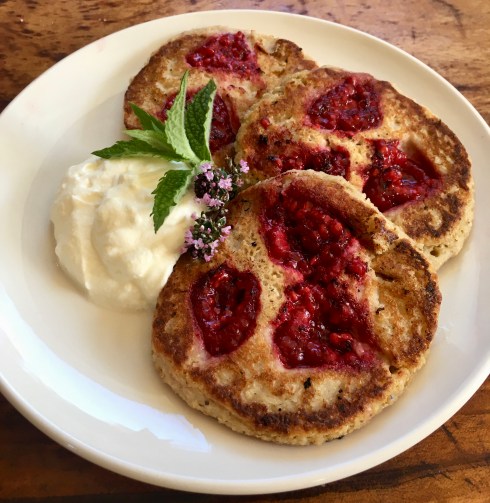
Meanwhile we’re making delicious raspberry pancakes, perfect for summer breakfasts/brunch – kind of healthy and decadent at the same time. Made with oats and squashed banana they are surprisingly sophisticated and banana-flavour free. They take no longer to make than a fry up with the added bonus of twice the vitamins and antioxidants.

Any berry could be used for this recipe, fresh or frozen but a lot of them have travelled a long way. There are some delicious local raspberries available at the moment. If you haven’t got your own raspberries to pick, these are the next best thing  – big fat berries with a powerpack of flavour.

fullsizeoutput_14c7.jpeg

Eat the pancakes naked, or drizzled with maple syrup or honey and a dollop of Greek yoghurt .


Makes 8 little pancakes – multiply the recipe for crowds.

For a vegan version substitute the eggs with 50mls extra plant milk


Raspberry pancakes


100g oatflakes

1 banana – roughly chopped

2 eggs –

100mls milk – any kind

1 heaped tsp baking powder

pinch of salt

1 tsp vanilla

1 punnet raspberries

oil or butter to fry


Put the oatflakes into a food processor and buzz until fairly fine.

Separate the eggs. Put the whites in a bowl and the yolks in with oats then add the milk, banana, vanilla and baking powder to the oat mix. Buzz until the mix is fairly smooth

Whisk the egg whites until stiff. Tip the oat mix into a bowl then gently fold in the whisked egg whites

Heat a frying pan and when the pan is hot add a smear of butter or a drizzle of oil. Spoon the mix in a tablespoon at a time, allowing space between each pancake so that they don’t stick together. Turn the heat to medium-low

Post a few raspberries into each pancake and when little bubbles begin to appear on the surface carefully flip the pancake over and cook the other side.


In Anticipation of Peas

fullsizeoutput_147f

It’s a busy time in the garden, lots to sow, transplant and weed but not a vast selection to eat. There are plenty of green things – salad leaves, herbs, baby spinach, a few bolting leeks but for the rest we are waiting.

This recipe is in anticipation of the peas.

Our peas are about 15cms tall and on the up, beginning to climb their chicken wire fence. There’s a way to go but they’re coming

There is still time to plant peas if you have the space. They enjoy the Irish climate and providing the mice don’t eat the seeds will soon emerge and start climbing up, grasping with tiny tendrils to whatever is close by so it’s best to make a fence to keep them where you want them.

The main reason I plant pod peas is because they are so sweet. We snack on them in the garden so probably only half the harvest hits the kitchen.

The secret with peas is to eat them as soon as you pick them, before the sugars convert to starch. This is why frozen peas are so successful and indeed can be superior to pod peas.as unless they were recently picked they will have become a little starchy.

These little green orbs have a lot going for them as they are a source of plant-based protein, officially a legume not a vegetable. Paired with eggs, a little fresh goats cheese or yoghurt to make a complete protein this makes a nutritious vegetarian option that is easy and fast to make.

I was going to make the recipe in the blender but there was a power cut so instead of buzzing the mix I got stuck in with  a potato masher  and the result was chunky pea in batter delicious so the recipe can be made either way. If you use a blender pulse buzz and stop before the mix is smooth.

We’re using Sunview fresh goats cheese, which comes from Kilmichael near Macroom. Goats cheese has a dodgy reputation but this new season fresh cheese is creamy and delicious, not in the least bit goaty.

If you can’t handle goats cheese use a little feta or leave it out.

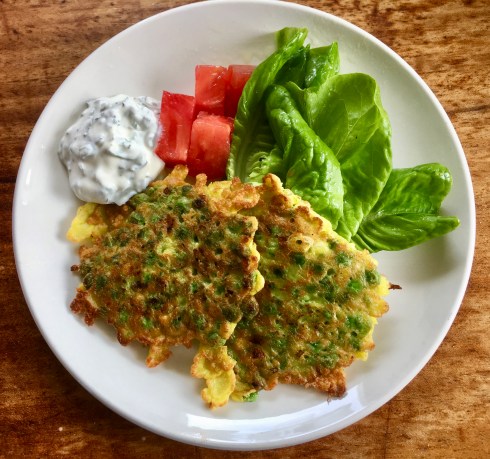
We ate these with mint and yoghurt sauce and salad on the side.


Pea fritters


300g peas

3 eggs

3-4 spring onions

zest of half a lemon

50g crumbled fresh goats cheese

50g cornflour

½ tsp baking powder

½ tsp salt

oil to fry.


Bring apot of water to the boil , add the peas then cook for 3-4 minutes. Drain and refresh under the cold tap then put aside .

Crack the eggs into a bowl. Seive the cornflour and baking poiwder then whisk into the eggs together with the slat.

Finely chop the spring annions then stir into the batter with the lemon zest, goats cheese and peas. Mash with apotato masher to crush the peas.

Heat a frying pan, pour in a little oil – enough ti just cover the bottom of the pan. Spoon in 3 or 4 tablespoons of the batter, allowing each fritter to spread but not join up. Turn the heat to medium and fry the fritter for 2-3 inutes then flip over and cook the otherside. Repeat until the mix is used up. I made 10 fritters.


Mint Yoghurt Sauce


250mls Greek yoghurt

1 tbs finely chopped mint

salt. And cracked black pepper.


Mix te yoghurt and finely chopped mint together then season with salt and cracked black pepper.


Moros y Cristianos, a recipe from Cuba

This recipe comes from Cuba, it’s not exactly a culinary hotspot but the music is wonderful. Sitting in the Caribbean, this fiercely independent island is big – more than one thousand kms long and more or less one hundred and fifty kms wide, surrounded by picture postcard sea which produces an abundance of fish, prawns and lobsters
We landed into Havana, a city of crumbling elegance and lethal footpaths.

IMG_2818

We stay in casa particulares – Cuban B and Bs. These rooms in private houses are super simple and clean, furnished with furniture of the fifties and sixties or before. The hospitality is fantastic and we have travelled from one casa to the next through the owners network of connections. The casas provide breakfast too. It was pretty paltry in Havana but once in the countryside there’s plenty of fruit and eggs. The people are super friendly and everyone has time to chat. Most houses have a porch where the family hangs out and rocking chairs are the norm.

IMG_2926

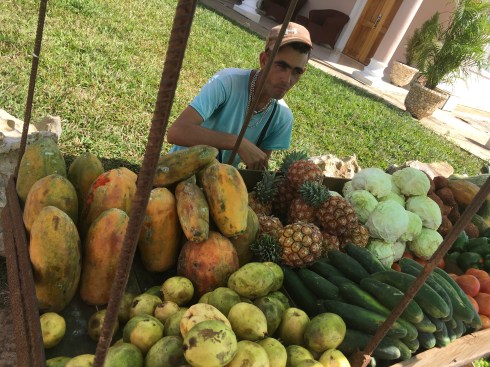
Shops don’t exist as we know them but there are vendors selling bananas and pineapples and cubby holes in the front of the houses selling pizzas and pastries.
Finding a bus is a mystery but there are plenty of taxis – Chevrolets , Cadillacs, Buicks, horse drawn carriages and cycle taxis in the towns. Getting around takes time, we have been travelling by taxi collectivos – shared taxis, much easier to organise than the bus and the same price.

IMG_3318

KInd of fun as you never know who you might meet and what sort of vehicle it might be. We started one journey in an air con car feeling very chuffed with ourselves only to be decanted halfway into a little truck that bumped along for the next six hours.  There’s one main highway which is relatively well maintained but off of that the roads are well worn.

IMG_2864
We headed west out of Havana to Vinales, up to the hills, where horses are one of the main modes of transport,the fields are lush with tobacco, coffee, fruit and vegetables then we went east to Trinidad, an old sugar plantation town We fell in love with Trinidad with it’s cobbled streets, colourful houses, mojitos and music everywhere.

IMG_3160

Each evening the Plaza Mayor hosts different musicians and everyone hops up salsa dancing. There’s also the bonus of a beach, admittedly 14kms from the town but we rented bicycles and headed out to swim each day before hitting the town for the night. This is where our plan to traverse the entire island fell apart. The thought of more twelve hour bus journeys plus the return was easy to talk ourselves out of and we ended up behaving like Cubans and taking time to enjoy each day at a leisurely pace.
At the moment we are in Cienfuegos with it’s beautiful French colonial architecture, known as the Paris of Cuba but nothing like that in size..

IMG_3345

We’ll wind our way back to Havana via Santa Clara, a key town of the revolution  (where Che Guevara was finally laid to rest) then back to Havana to catch the famous ballet before travelling home.
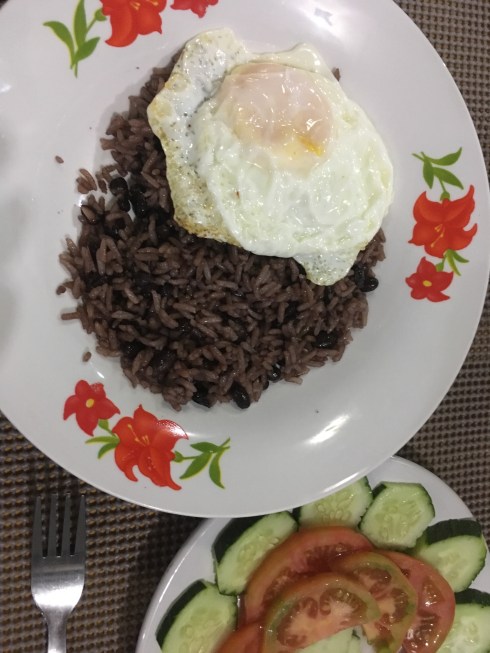
We resisted travel to Cuba for along time as we’re so preoccupied with food but we are now totally smitten and do you know what, arroz y frijoles – beans and rice- the national dish isn’t too bad and you can survive quite healthily on this diet especially if you put prawns, lobster or a fried egg on top!

IMG_3027

Arroz y Frijoles – Beans and Rice

150g black beans
300g long grain white rice
1 onion – peeled and finely chopped
2 cloves garlic – peeled and finely chopped
1 tbs oil
Salt

Cook the black beans in plenty of water – they will take about 45 minutes. Check the beans are tender then drain, reserving the cooking liquid. Measure the cooking liquid and make it up to 450mls with water. Put the rice into a saucepan together with the cooked beans and measured cooking liquor and a good pinch of salt. Bring to the boil then cover with a lid, turn to the lowest simmer and cook for a further 20 minutes.
Fry the onion gently in a little oil until soft and translucent then stir in the garlic and cook for a few minutes longer. When the rice is cooked mix the onion and garlic through and you’re ready to go.
Recipe given to me by Aliente in Vinales


What’s With The Cabbage?

Before Xmas I received an email asking me if I had thought about what we were going to do for Veganuary in the shop (eating vegan food in January) it was from someone called Shane whom I presumed to be Shane Red Strand Coffee. I shot back an answer saying thanks for the idea, that it could be good fun and the next thing we got a box of samples in the post from a different Shane altogether of pretty vegan products!

The Veganuary idea does seem like a good idea  – to detox after Xmas, cut down on emissions by not eating meat and generally save our selves and the planet. And we have a lot of vegetables still growing in our garden.

The warm wet weather has the cabbages shining brightly, the leeks are standing to attention and the green stuff – parsley, spinach and kales are quite happy so there’s plenty for eating.

img_2224

Just the thing for a January detox – I have to say although I don’t take detoxes too seriously, I do think it’s good to make a little effort especially after all the feasting.

img_2366

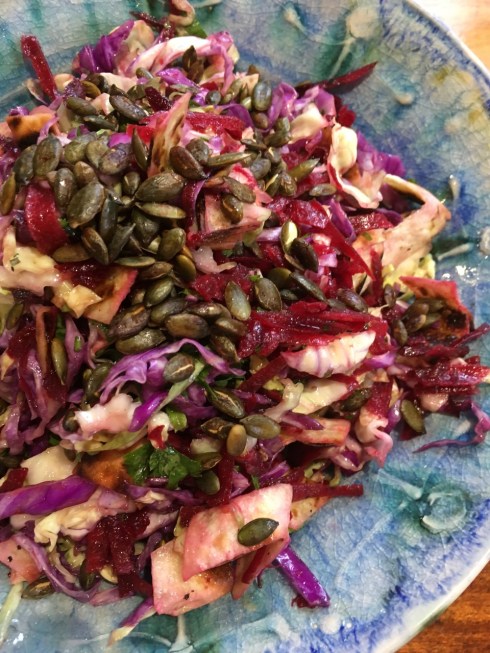
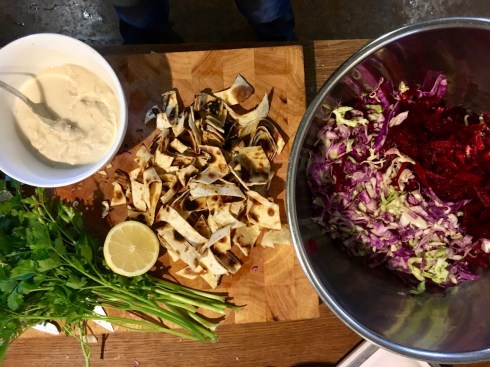
My son Darragh came up with this recipe. He was home for Xmas and knocked this up for lunch one day. I had just come in from a walk and was ravenous. I thought this was delicious. The lightly pickled cabbage, grated beetroot, toasted seeds and something else that had a very interesting texture and flavour but wasn’t a vegetable. It was double toasted, shredded tortilla wrap. Highly recommended especially served with tahini sauce.

The recipe will make a large bowlful. Scale the recipe down proportionately if you want less.

Not yet named salad

2tbs olive oil + 50mls for dressing

1 fatty clove garlic

½ small red cabbage

½ sweetheart or york cabbage

1 tsp salt

1 large beetroot

1 bunch parsley – chopped

150g pumpkin seeds

tamari

2 large tortilla wraps

50mls lemon juice


Peel the garlic then finely chop – crush in a mortar if you have one – together with a little salt. Mix with 2 tbs olive oil . Leave aside.

Wash and tidy up the cabbage then slice thinly.

Begin slicing from the top of the cabbage, then half way down cut the cabbage in half and remove the stem. Finely slice the remaining cabbage

Put into a large bowl and toss with a teaspoon of salt. Leave the cabbage aside.

Peel and grate the beetroot.

Heat a small frying pan, turn the heat to medium and add the pumpkin seeds. Gently toss or stir until they begin to colour and smell a little toasty. Remove the pan from the heat and sprinkle over soya sauce or tamari. Tip into a bowl and put aside to cool.

Heat a large frying pan then reduce the heat to medium and fry the tortillas, on at a time, cooking each side until it becomes a little toasty (not burnt). Brush the tortillas with the garlic oil and cook briefly once again. Stack the tortillas then roll them into a loose cigar. Cut on the diagonal to make wedge shaped pieces.

Put a clean t-towel on the counter. Put the cabbage handfuls at a time over half of the towl – don’t tip the bowl because all the excess liquid will follow. Fold the t-towel over the cabbage and pat dry then gently roll the towel and pat again . Tip the cabbage into a clean dry bowl.

Add the grated beetroot and chopped parsley.

Drizzle over the olive oil and lemon juice then toss to mix.

Add half of the pumpkin seed and the shredded tortillas then toss again

Tip into a clean bowl and sprinkle pumpkin seeds on top.

img_2355


Tahini Sauce


Juice 1 lemon

1 clove garlic, peeled and finely chopped

2 big tbs light tahini

a pinch of salt

a little water to thin the sauce

Put all of the ingredients into a bowl except for the water and whisk until amalgamated. Thin with water to achieve a thick pouring consistency.

This salad is best eaten soon after making. Don’t forget to drizzle tahini sauce on top

img_2374


Fatty Chickpeas

IMG_2316

I have had a packet of dried chickpeas in my pantry for months. A packet that i carried all the way home from Spain but never got around to cooking. Mostly because I forgot to soak them. They are big chickpeas – bigger than the ones we can buy in Ireland by far –  I’d say double in size and delicious when cooked. It may sound mad to get excited about chickpeas but soaked overnight and cooked for 30 minutes they are ready to go, unctuous and creamy, which is quite something. The one’s we buy locally  take three or four times as long  to cook and are like little bullets.

It’s still the holiday season here and we have been valiantly making our way through our veg box which together with the pre-cooked chickpeas offered numerous possibilities for dinner. The winning dish was also a lazy dish. It didn’t take very much effort, more the availability to give the odd stir.

Take time sautéing the veg, they will become sweet and more flavoursome.


Chickpea Supper Pot with Almond and Basil Picada

1 onion – peeled and chopped

100mls olive oil

1 carrot – peeled and diced

1 small bulb fennel- sliced into skinny wedges

2 stems celery – diced

3 cloves garlic- peeled and chopped

2 ripe fat tomatoes or 1 can tomatoes – chopped

1 glass white wine (optional)

200mls chickpea liquor or water

2 bay leaves

a handful of parsley

salt and pepper


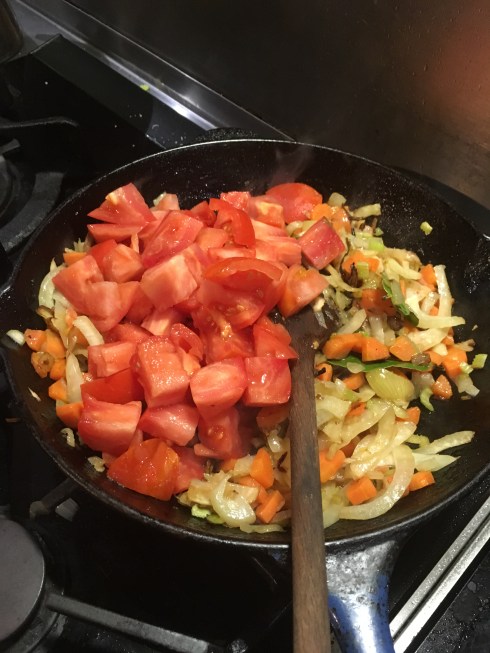
Heat a frying pan or skillet. Add the olive oil and the chopped onions, give them a stir and when they are sizzling  season with a little salt. Stir in the fennel, celery, bay leaf and carrots, give a stir and when the veg are all sizzling season with a little salt then turn the heat to medium/low. Cook, stirring now and then, gently sizzling for ten minutes. Add the chopped garlic then continue cooking for five minutes.

IMG_2313

Add the chopped tomatoes and white wine, bring to the boil then turn to a simmer for ten minutes

IMG_2314

Stir in the chickpeas and cook for a further ten minutes. Add a little chickpea cooking liquor or water if needed. Season with salt and pepper. Stir in the chopped parsley

IMG_2325


We ate this with a little picada/pesto to drizzle over and crusty bread

Picada

1 small slice bread, crusts removed and cubed

olive oil

15-20 blanched almonds

1 clove garlic

small handful soft green herbs – I used basil but parsley or coriander would work too

salt

IMG_2317

Heat a small pan, add enough olive oil to cover the bottom and the bread cubes, fry until they begin to go golden then add the almonds. Cook for another couple of minutes.

Putvthe bread/almond mix in a processor together with a clove of garlic then buzz to a crumb.

Add the herbs then drizzle in enough olive oil to make the cicada move. Season with a pinch of salt


Bring on the Beans

fullsizeoutput_1199

The shorter, cooler days of November give me the opportunity to indulge my bean and lentil obsession. Beans and lentils grow where the climate is warm and sunny yet I’m inclined to eat them more often when it’s cold. A bowl of thick, creamy lentils or beans is an inexpensive source of protein which will slowly release energy to fuel your body and comfort your soul.


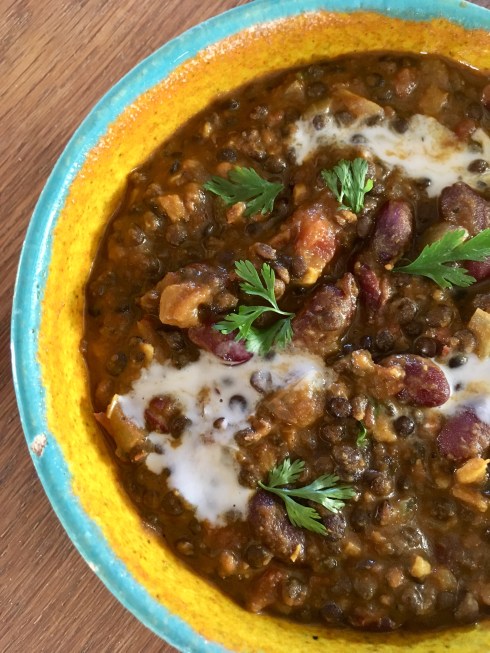
Dal Markhani is a recipe from the north of India, which uses both lentils and beans served in a sauce of fragrant spices. Markhani is a sauce of butter, tomato and cream but in order to slot this recipe into my ‘live to be one hundred’ recipes file I have used coconut milk and vegetable ghee/oil instead of the dairy but feel free to swop it back.


The original recipe also uses black urad dal, a type of black mung bean, which takes an overnight soaking and then three or for hours to cook. Healthy as urad dal might be it’s not really in synch with our fast paced lives so they have been dumped in my recipe in favour of black beluga lentils, which are one of the gems of the lentil family. Black, round and robust they cook in 20-25 minutes and keep their shape whilst doing so. No mealy mass even if you forget them and decide to walk the dog whilst cooking.


There’s a fast version and a slow version for this dish, both have their merits but I’m going for the fast version and opening a can of beans. The lentils I cook from scratch.


Dal Makhani


1 large onion

50g vegetable ghee or oil

25g fresh ginger

3 cloves garlic

2 cardamom pods

3 cloves

2tsp ground coriander

1 tsp ground cumin

1 tsp turmeric

1 can tomatoes

½ tsp salt

1 can kidney beans

200g beluga lentils

150mls coconut milk

chopped fresh coriander to serve


Put the lentils into a saucepan with three times the volume of water. Bring to the boil then simmer for 20-25 minutes, until the lentils are tender. Put aside.

Peel the onion then chop finely.

Heat a medium saucepan then add the vegetable ghee or oil and the onions. Cook on a medium heat without browning until they soften.

Peel and chop the ginger and garlic then stir into the onions. Bash the cardamom pods with the back of a wooden spoon so they crack open then add to the pot together with the cloves. Cook gently for a couple of minutes then add the ground coriander, ground cumin and turmeric. Stir and gently cook for a few minutes more then stir in the tomatoes and salt. Allow the sauce to come to the boil then simmer gently for 30 minutes.

Drain and rinse the kidney beans.

Add the beans, the beluga lentils and residual cooking liquid to the tomato sauce. Cook gently for 15-20 minutes. Stir in the garam masala and most of the coconut milk then taste . It’ll probably need a little more salt. If it’s too thick thin with a little water

Serve with chopped coriander and a swirl of coconut milk to garnish.

Eat with rice or mop up with naan bread.


Aliens in the Vegetable Patch

fullsizeoutput_1130

Autumn is my favourite time for eating from the garden, there is such an abundance to choose from. The tomatoes in particular seem to have reached peak sweetness, perhaps it’s the long slow ripening on the vine. It is the reason we keep gardening as it’s impossible to buy this flavour.

We have harvested all our apples and potatoes and the beetroots are ready for eating. The beans and courgettes keep making a last ditch effort, everytime that the sun comes out they decide to have another go, so although we’re no longer picking bucketsful there’s plenty for dinner.

We have the best crop of pumpkins – almost ready- after the glorious summer. Pumpkins don’t like to grow below 18c and the prolonged heat this year really boosted them along. We’re delighted as this precious crop will store right through the winter.

The stars of the moment are the cauliflowers, which have appeared like aliens in the brassica patch. All at once! Which means there’s quite some cauliflower eating to be done so it goes without saying that this months recipe is with cauliflower.

I’ve combined the cauliflowers with pumpkin so it could also be a Halloween recipe.

The measurement for the pumpkin and cauliflower are guidelines as obviously cauliflowers don’t grow in half kilo units. They do not have to be exactly 500g, just roughly equal amounts of each. The amount of eggs also depends on the size so use two large eggs or three smaller ones.

I used salted ricotta for these fritters. Pecorino and Parmesan would also be good substitutes and who knows, maybe cheddar would work too but I have not tried this variation.


Cauliflower and Pumpkin fritters


500g pumpkin

500g cauliflower

2-3 eggs – lightly beaten

200g salted ricotta – grated

a large handful of parsley finely chopped

salt and pepper

oil for frying


Put a large pot of salted water to boil.

Peel the pumpkin and remove any seeds then chop into equal sized pieces of roughly 2cm each.

Wash the cauliflower well then cut into florets.

When the water is boiling add the pumpkin, as soon as the water returns to the boil turn the heat to medium /low because if the pumpkin is belting around in the pot the pumpkin will become fluffy. Cook for 10-15 minutes, until a knife will enter without resistance. Lift the pumpkin from the water then leave to drain in a colander.

Return the pot to the heat and add the cauliflower, cook for 4-5 minutes, just enough to take the edge off the rawness.  Drain into a colander and give it a good shake to remove excess water.

Gently mash the pumpkin and season with salt and pepper.

Put the cauliflower florets onto a chopping board and chop to small pieces paying particular attention to the stalks.

Put the pumpkin and cauliflower into a large bowl together with the beaten eggs and grated cheese and mix together with your hands.

Give the mix a good squish and it will hold together. Form the mix into golf ball sized pieces.

Heat a large frying pan and add enough oil to cover the bottom. Gently flatten the fritters and fry on a medium heat, flipping half way, until  golden on both sides.


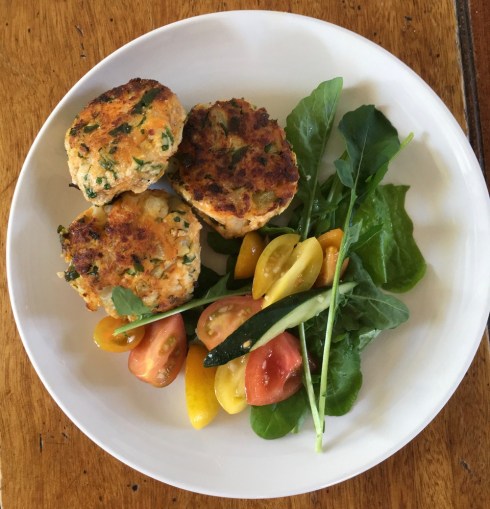
These are best served with some kind of sauce/salsa. We ate ours with chopped tomatoes, olive oil and balsamic but when the tomatoes are gone we’ll move onto avocado salsa, yoghurt sauce or mayo.